The Roja Dove Of Central Europe
Towards the end of the Bonkers Grand Tour – so called because it took in eight countries in under three weeks – I found myself in Budapest on a Monday with no appointments. Thinking this might be my one and only visit to the city, I decided to spend the day sightseeing. After four hours of pounding the tree-lined boulevards and clambering up and down the hill to the famous castle district, I was making my way back to my hotel, decidedly weary and footsore by this stage. Having recently enjoyed two days of dedicated perfume sniffing in Dresden and Vienna, perfume was not on my mind that day as I strolled through the pedestrian precinct behind the riverfront.
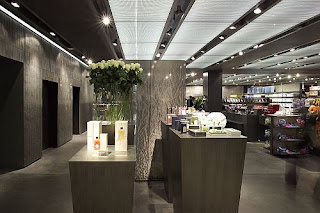
Suddenly, however, I spied an upmarket clothes store with what appeared to be a niche perfume boutique at one end, called Le Parfum Croisette.
 “Oh, okay then”, I thought to myself. “I’ll just stick my head in quickly and see if they have anything I don’t know...”
As I stepped inside, I immediately spotted the Dutch Puredistance range of perfumes facing the doorway, and flashed a grin of recognition at the proprietor, who was sitting in front of the display on a bar stool. Perhaps sensing that I was no ordinary punter, he invited me to take a seat on the other stool, and we ended up chatting for the best part of an hour and a half.
And if I was no ordinary punter, the owner of Le Parfum Croisette was most definitely no ordinary owner of a perfume store. For he turned out to be none other than Hungary’s one and only perfumer, Zsolt Zólyomi. Is there a particular term for that – “solinose”, perhaps? I was lucky to catch him in the store in fact, for he has so many other scent-related projects; indeed the boutique itself is as much a showcase designed to raise public awareness of niche fragrances as it is a sales outlet - if not more so.
 In the course of our chat, Zsolt gave me a quick rundown of the history of fragrance in his country, which has its roots as far back as the 14th century. For Hungary contributed the first alcohol-based perfume ever made – L’Eau de La Reine de Hongrie – an astringent cologne containing rosemary oil, which was said to have rejuvenating properties. Whether frequent dousing in her eponymous water had anything to do with it or not, Queen Elisabeth certainly lived to a ripe old age.
Then during the Communist era in the 20th century the fragrance industry in Hungary was suppressed as an elitist indulgence, and it is only now that people in Central and Eastern Europe are starting to discover fine fragrances and embrace the concept of luxury goods generally. However, Zsolt feels he has his work cut out in promoting the cause of niche perfume lines, for Hungarian people’s tastes have not evolved very far: women typically favour accessible scents – either quite sweet perfumes or fresh florals such as D & G Light Blue. They are easily swayed by advertising and tend to follow the crowd and whatever brands are “in” at the time. So not unlike everywhere else, then...!
 Fired up with missionary zeal to revive Hungary's perfume traditions, Zsolt is deploying every means possible to further the cause of high end fragrance everywhere “east of Prague”, seeing himself very much as an ambassador for perfume. He plans to launch a Perfumery School for students from the CEE countries, and open the first Hungarian Perfume Museum.
 Some day he would also like to create a brand of perfume that captures the essence of Hungarian culture. This may not be it, but he also fancies creating a scent with a burnt smell. "Aha", I said: "That sounds a bit like Christopher Brosius of CB I hate perfume and his Burning Leaves". Now I am not sure quite what style of burnt matter Zsolt has in mind, but he is clear that it must not smell like a particular type of Hungarian cheese which also boasts a burnt aroma, thanks to the way it is matured I think (I am afraid I can't remember the specifics!).
But meanwhile, as Hungary’s only perfumer, Zsolt already has an awful lot on his plate...
 His fragrance consultancy service is wide-ranging: he creates commercial perfumes for brand owners (Rajul and Nubia, a mixable His & Hers range commissioned by Emeshel, a US "lifestyle brand" with Hungarian roots. The perfumes complement its existing line of high end jewellery, crystal and sculptures.) Zsolt also creates custom scents for private clients (including the wife of actor Roger Moore), and for use in corporate gifts (eg candles). Additionally Zsolt produces scented events aka "olfactive animations" - “from weddings to fashion shows, from theatre acts to product launches and parties, where I choose or create the best ambiance fragrance matching the event".
 Another type of service is the tongue twisting “interactive olfactive animation”, where Zsolt might give a talk, and involve the audience through scented games or quizzes, or a spot of fragrance consulting or a mini-demonstration of the art of perfumery.
 In addition to his roles as pundit, educator, marketeer and all-round scent evangelist, Zsolt is the author of a book on perfume: Le Parfum 2000. It was in Hungarian, but on flicking through I was reminded of Roja Dove's later work, The Essence of Perfume, with its general overview of the subject, historical approach, and illustrations of scent bottles and adverts down the ages.
I was also keen to hear the origins of Zólyomi’s love of fragrance. It turns out that he was fascinated by smells from an early age, and a year spent in Libya aged 10 fuelled his interest further. Rajul for men is inspired by the coastline of Zsolt's adopted childhood home, and blends the tangy scents of grapefruit and sea salt in a whimsically suggestive bottle.
 Zsolt trained as a plant biologist originally, and later studied at the ISIPCA in Paris, the school for postgraduate studies in perfume, cosmetics and food flavouring. He qualified in 2005 and set up Le Parfum Croisette in 2009. I clocked the following ranges, with a full listing available on the store's website: Puredistance, Frapin, L’Artisan Parfumeur, Annick Goutal, Atelier Cologne, The Different Company, Juliet Has A Gun, Etro, Penhaligon’s, Reminiscence, Odin and India brand Sahlini (of which more anon).
Part 2 will cover what we actually sniffed, but there is one final amusing tale to report...
One of Zsolt's "olfactive animation" projects involved creating an ambient fragrance for the Kogart museum in Budapest. "If you are quick and walk as fast as me, you'll be there in 15 minutes", Zsolt said brightly, so after I left him I hotfooted it up the museum, only to find two buildings bearing that name, both of which had just shut.
 Outside the first building a female member of staff was standing on the doorstep, possibly waiting for a lift home. In vain did I try to explain that - as per my original intention with Le Parfum Croisette itself - I just wanted to stick my head inside the door, in this case to sniff the air and satisfy my curiosity about Zsolt's ambient "scent installation". The girl spoke no English, so in the end I nipped past her and stuck my head inside the open door anyway, ostensibly to illustrate my point! The foyer didn't smell of anything.
So I headed on to the other building called Kogart, which was more or less next door. Its restaurant at least was open, and there were a couple of security guards loitering in the empty eaterie. They spoke some English and knew all about Zsolt's museum fragrance. "It's expensive stuff!" one guard remarked, "but it isn't used here in the restaurant, and the rest of the building is shut now, sorry."
 Ah well, that was too bad, but my serendipitous encounter with Zsolt was more than enough excitement for the afternoon. Another reason to go back to Budapest some day... By which time, Zsolt may have come up with his own quintessential Scent of Hungary. If so, it will be 100% his own creation, and will not have been focus grouped beyond all recognition. For somewhere in our chat I mentioned in passing what I do for a living, to which came Zsolt's laughing reply: "Ha! I don't do market research."
 I like him all the more for it.
Photo of Eau de la Reine de Hongrie Water label from perfumeprojects.com, photo of Rajul and Nubia perfume range from popsop.com, photo of Libyan coastline from africanews.com, other photos my own